Flat pacing
Possible synthesis, but also scripting, fatigue, or careful narration.
 AI Voice Detector
Listening guide
Synthetic speech may show timing, texture, or transition problems, but none of these signs proves a clip is AI. Use them to select samples and decide what to verify next.
Check a suspicious sample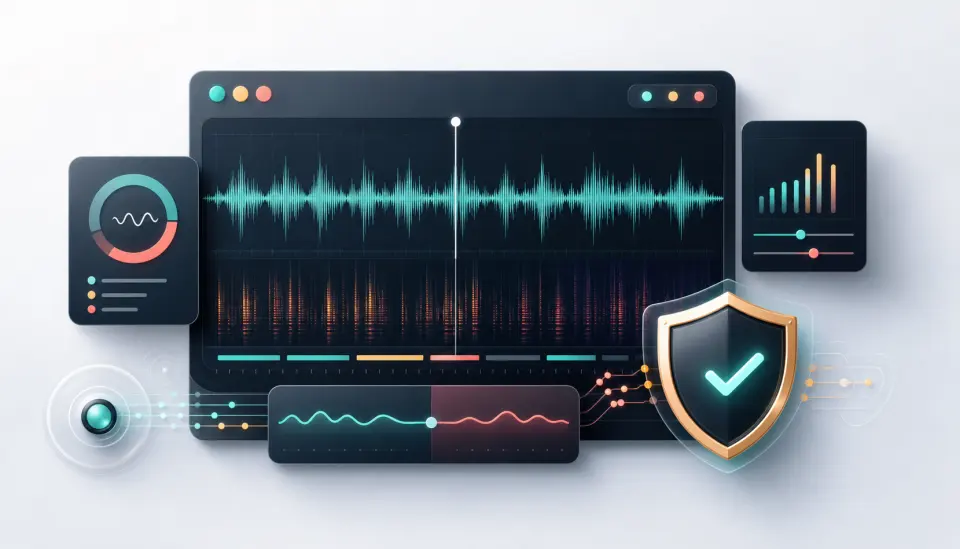
Possible signs include unusually even pacing, unstable voice texture, awkward breaths, clipped word transitions, and emotion that does not match emphasis. The same effects can also come from compression or editing, so confirm with a detector and source review.
Listen for pauses that arrive at unnatural grammatical points, words that run together without normal preparation, or pacing that stays mechanically even through a long sentence. Some generated voices place emphasis correctly at the start and then flatten toward the end. Others sound polished word by word but do not carry a natural thought across the whole phrase.
Timing is not proof. Scripted presenters, accessibility tools, non-native speakers, tired speakers, and aggressive editing can all change rhythm. A useful review compares several sentences and asks whether the pattern is consistent, rather than treating one unusual pause as a verdict.
Pay attention to changes around consonants, breaths, laughter, whispered words, and quick shifts in pitch. A cloned or generated voice may briefly lose texture, become too smooth, or change room tone between words. Names, numbers, and rare terms can expose transitions because the system has less predictable context to work with.
Platform processing can produce the same symptoms. Noise removal may erase breaths, a low-bitrate message may smear consonants, and speakerphone playback may add a hollow or metallic quality. Try to obtain the original file before concluding that a texture problem came from generation.
A voice can sound emotional and still be synthetic. Modern cloned speech can imitate urgency, calmness, anger, or distress. Look for whether emphasis follows the meaning of the sentence and whether the speaker reacts naturally to changing context. In an interactive call, delayed or generic responses may matter more than a polished opening statement.
The request itself is often the strongest warning. Unexpected secrecy, pressure to act immediately, a new payment destination, refusal to switch channels, or a claim that normal verification is impossible should trigger a pause. Those behaviors are risky whether the voice is generated or human.
Mark the cleanest suspicious section and test it, then compare the result with the source. Search for the original upload, check the account history, and see whether trusted channels carry the same statement. If the clip imitates someone you know, contact that person through a number or account you already trust.
Describe findings precisely. Say that a selected segment shows possible synthetic signals, not that a person definitely created a fake. Preserve uncertainty when the sample is short, edited, noisy, or near the middle of the detector range. That language prevents a screening result from becoming an unsupported accusation.
Possible synthesis, but also scripting, fatigue, or careful narration.
Possible generation, but also noise removal or tight editing.
Possible processing artifact, often caused by low-bitrate audio.
A fraud warning regardless of whether the voice is AI or human.
There is no single definitive sign. Repeated timing, texture, and transition problems across clean speech are more useful than one odd word.
Yes. Generated voices can include breaths and emotional delivery, so their presence does not prove a voice is human.
Compression, denoising, poor microphones, phone networks, scripted delivery, illness, and re-recording can all change natural speech.
Preserve the source, test a clean sample, and verify the speaker or publisher through an independent trusted channel.